

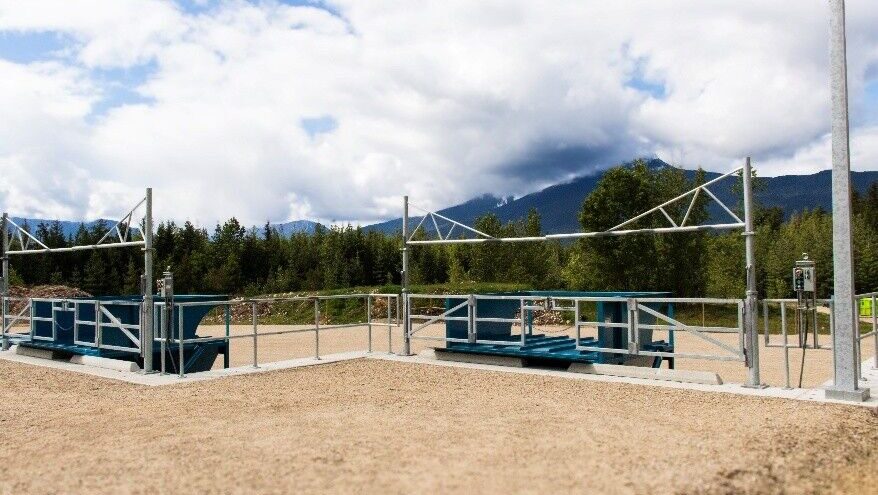

Major upgrades at the Nakusp Waste Facility have wrapped up, with the Regional District of Central Kootenay (RDCK) now preparing to close the local landfill later this month.
The facility has undergone substantial improvements over the past two and a half years, including the installation of a new tipping area and compacting bins.
The RDCK said the work is part of a long-term strategy to enhance waste management services, control costs and improve environmental performance as the district prepares for the eventual closure of the landfill.
The landfill will cease operations on Nov. 24, when it reaches the limits of its current footprint.
The RDCK said the closure will not affect most site users. Residents can continue to dispose of household garbage and most recyclables at the new transfer station once it is fully operational.
Existing areas for clean wood, metal, tires, tanks, and yard and garden materials will remain unchanged.
Staff will provide direction for any materials not suitable for bin disposal.
Consolidating landfilling throughout the regional district was recommended in 2009 to reduce operating costs and improve environmental outcomes.
Right now, the RDCK’s landfills operate without engineered liners or leachate treatment systems. These systems are not required for existing landfill cells, but any new ones would need costly infrastructure to meet modern standards.
The RDCK said transitioning the Nakusp site to a transfer station and hauling waste to Ootischenia will help the region avoid the higher costs of meeting those standards.
Environmental benefits
More than 90 per cent of waste-related emissions in Nakusp come from landfill decomposition rather than transportation.
While hauling waste to Ootischenia may slightly increase emissions in the short term, the RDCK expects significant reductions by the mid-2030s, when the Ootischenia site begins managing landfill gas – an initiative not feasible at smaller sites such as Nakusp.
The Ootischenia Landfill will be developed as an engineered facility, with liners and a leachate collection and treatment system, reducing the impact of waste on the surrounding environment.
What to expect after the closure
The RDCK said allowances will be made for some disposals not normally accepted at RDCK transfer stations during the first year after closure to ease the transition.
Staff will try to accommodate larger disposals (greater than five cubic metres or 2,000 kilograms) from residents, municipal partners and contractors through load assessments on a case-by-case basis.
Loads that exceed bin capacity or pose a threat to infrastructure or hauling safety – such as dense boulders or concrete that can damage bins or create weight imbalances – will be directed to Ootischenia for disposal.
As with all RDCK transfer stations, the following controlled wastes will not be accepted at Nakusp once landfilling ends:
-
Contaminated soil
-
Municipal wastewater biosolids
-
Dead animals (quantities over 121 litres or 27 imperial gallons)
-
Land-clearing debris (quantities over 1.5 cubic metres)
-
Asbestos-containing materials
A full list of accepted controlled waste materials is available here.
The Nakusp Transfer Station will continue to operate its septage pit until alternative service options are assessed for the Nakusp area.
Looking ahead, the RDCK said it is actively exploring construction, demolition and renovation waste diversion options to reduce the need to haul this heavy, bulky waste to Ootischenia.
“We appreciate the community’s patience throughout this transition,” said Uli Wolf, RDCK general manager of environmental services.
“We’re proud to offer a modern, efficient and environmentally responsible waste management solution for Nakusp.”
Want to get your business noticed? Have you considered advertising through your local radio station? Speak to one of our sales agents and find out how radio advertising can boost your business today. Call 250-365-7600 or email Vista Radio.